By ELÉONORE HUGHES and LUCAS DUMPHREYS Associated Press
RIO DE JANEIRO (AP) — Towering talipot palms in a Rio de Janeiro park are flowering for the first and only time in their lives, decades after famed Brazilian landscape architect Roberto Burle Marx introduced them in the 1960s.
Towards the end of its life — which can span between 40 and 80 years — the palm tree sends up a central plume crowded with millions of small, creamy-white blossoms that rise high above its fan-shaped leaves.
The rare phenomenon that ties past to present has sparked the curiosity of passersby in Flamengo Park who stop, crane their necks to admire them and take photos.
Vinicius Vanni, a 42-year-old civil engineer, was even hoping to collect seedlings and plant them.
“I probably won’t see them flower, but they’ll be there for future generations,” he said from Flamengo Park, which hugs a nearby beach and offers a spectacular view of Sugarloaf Mountain.
Originating from southern India and Sri Lanka, the talipot palm can reach up to 30 meters (98 feet) in height and produce around 25 million flowers when it blossoms, using energy accumulated over decades.
If the flowers are pollinated, they produce fruits that can become seedlings.
In addition to Flamengo Park, the talipot palms can be found in Rio’s Botanical Garden, where they are also flowering.
That’s because they were brought across from southern Asia together, have the same metabolism and have been exposed to the same Brazilian rhythm of daylight, according to Aline Saavedra, a biologist at Rio de Janeiro State University.
Saavedra said that environmental laws strictly regulate transporting species native from another continent, although talipot palms are not invasive due to their slow development.
The interest the phenomenon has generated is positive and could encourage a sense of belonging for human beings to preserve rather than destroy the environment, according to Saavedra.
“This palm species gives us a reflection on temporality, because it has roughly the same lifespan as a human being,” said Saavedra. “Marx also wanted to convey a poetic perspective.”
___
Follow AP’s coverage of Latin America and the Caribbean at https://apnews.com/hub/latin-america
News
Decades-old palm trees in Rio de Janeiro flower for the first — and only — time
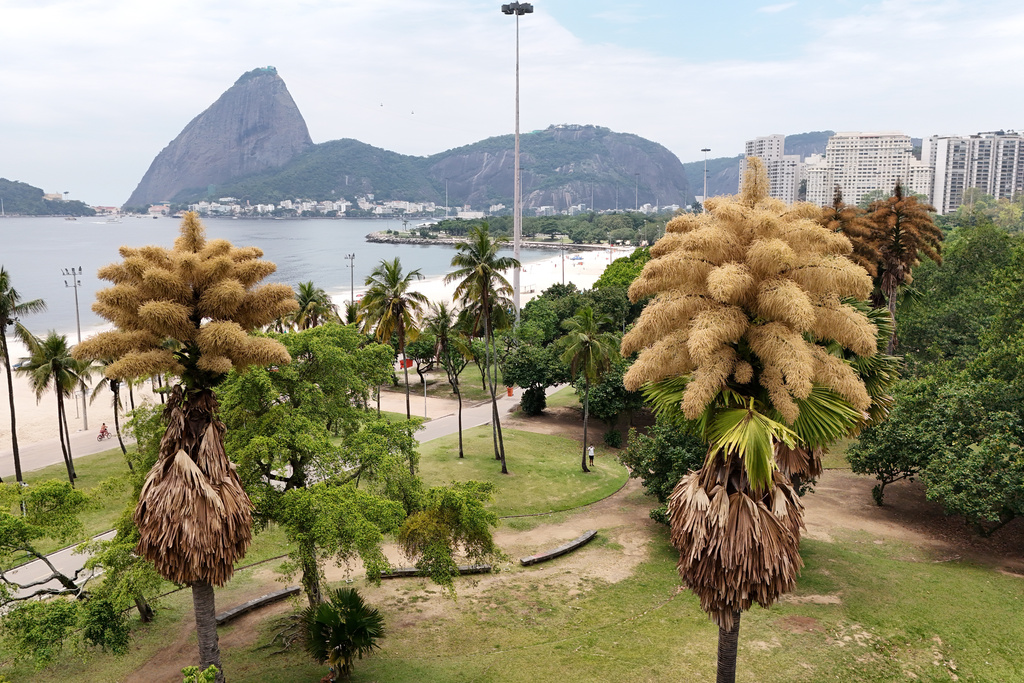
The Talipot palm trees, native to India and Sri Lanka, is in bloom for the first and only time in its life, in Aterro do Flamengo, Rio de Janeiro, Tuesday, Dec. 2, 2025. (AP Photo/Lucas Dumphreys) Photo: Associated Press